Sixth International
Conference on
Principles of
Knowledge Representation
and Reasoning
(KR'98)
Conference and Workshops
Information Brochure
Centro Servizi Culturali
S. ChiaraTrento, Italy
June 2-5, 1998
Sixth International
Conference on
Principles of
Knowledge Representation
and Reasoning
(KR'98)
| Download brochure and forms ready to print | A4 Postscript | Letter Postscript |
PDF Adobe Acrobat |
| Conference and Workshops Information Brochure | ![[get]](a.gif) (~580Kb) |
(~580Kb) |
(~85Kb) |
| Conference and Workshops Registration Form | (~32Kb) |
(~32Kb) |
(~14Kb) |
| Hotel-Banquet-Excursion Form | (~48Kb) |
(~48Kb) |
(~14Kb) |
We look forward to meeting you in Trento.
| Saturday, May 30 | ||||
| Sunday, May 31 | ||||
| Monday, June 1 | ||||
 | ||||
| Tuesday, June 2 | ||||
| ||||
| Wednesday, June 3 | ||||
| ||||
| Thursday, June 4 | ||||
| ||||
| ||||
| Friday, June 5 | ||||
| ||||
| Saturday, June 6 | ||||
| Sunday, June 7 | ||||
| Monday, June 8 | ||||
Department of Computer Science & Center for Cognitive Science State University of New York at Buffalo, USA shapiro@cs.buffalo.edu |
Division of AI School of Computer Studies University of Leeds Leeds, LS2 9JT, UK agc@scs.leeds.ac.uk
Lenhart
Schubert | ||
Giuseppe Attardi (U. Pisa, IT) Franz Baader (RWTH Aachen, DE) Fahiem Bacchus (U. Waterloo, Canada) John Bell (QMW Coll., UK) Alexander Bochman (Bar-Ilan U., IL) Mark Boddy (Honeywell Tech. Cent., USA) Alex Borgida (Rutgers, USA) Craig Boutilier (UBC, Canada) Ronen Brafman (UBC, Canada) Gerhard Brewka (U. Leipzig, DE) Tom Bylander (U. TX at San Antonio, USA) Marco Cadoli (U. Roma, La Sap., IT) Ernest Davis (NYU, USA) James Delgrande (Simon Fraser U, Canada) Francesco Donini (U. Roma, La Sap., IT) Didier Dubois (U. Paul Sabatier, FR) Alan Frisch (U. York, UK) Antony Galton (U. Exeter, UK) Hector Geffner (U. Simon Bolivar, VE) Malik Ghallab (LAAS-CNRS, FR) Robert Givan Jr. (Purdue U., USA) Georg Gottlob (T.U. Wien, AT) Adam Grove (NEC Res. Inst., USA) Thomas Gruber (Intraspect Software, USA) Nicola Guarino (LADSEB-CNR, IT) Peter Haddawy (U. WI-Milwaukee, USA) Bernhard Hollunder (Interactive Objects Software, DE) Henry Kautz (AT&T, USA) Jana Koehler (Albert-Ludwigs-U., DE) Gerhard Lakemeyer (RWTH Aachen, DE) |
Neal Lesh (U. Rochester, Mitsubishi Electric Labs., USA) Vladimir Lifschitz (U. Texas, USA) Gerard Ligozat (U. Paris-Sud, FR) Fangzhen Lin (Hong Kong U. of Science, HK) Robert MacGregor (USC/ISI, USA) David McAllester (AT&T, USA) L. Thorne McCarty (Rutgers, USA) Deborah McGuinness (AT&T, USA) Jack Minker (U. MD, USA) Leora Morgenstern (IBM TJ Watson, USA) Bernhard Nebel (Albert-Ludwigs-U., DE) Wolfgang Nejdl (U. Hannover, DE) Werner Nutt (U. des Saarlandes, DE) Hans Juergen Ohlbach (Imperial College, UK) Fiora Pirri (U. Roma, La Sap., IT) Massimo Poesio (U. Edinburgh, UK) David Poole (UBC, Canada) Teodor Przymusinski, Teodor (UC Riverside, USA) Anand Rao (AAII, AU) Raymond Reiter (U. Toronto, Canada) Irina Rish (UC Irvine, USA) Stuart Russell (UC Berkeley, USA) Marco Schaerf (U. Roma, La Sap., IT) Bart Selman (AT&T, USA) Murray Shanahan (QMW Coll., UK) Yoav Shoham (Stanford U., USA) Maria Simi (U. Pisa, IT) Aaron Sloman (U. Birmingham, UK) Michael Thielscher (Darmstadt U. Technology, DE) Miroslaw Truszczynski (U. Kentucky, USA) Peter van Beek (U. Alberta, Canada) Mary-Anne Williams (U. of Newcastle, AU) |
||
IRST-ITC, Trento, Italy kr98-local@irst.itc.it |
RMIT, Melbourne, Australia linpa@cs.rmit.edu.au
Paolo Traverso (local organisation) |
||
IRST-ITC, Trento, Italy franconi@irst.itc.it |
University of Rome ``La Sapienza'', Italy donini@assi.dis.uniroma1.it |
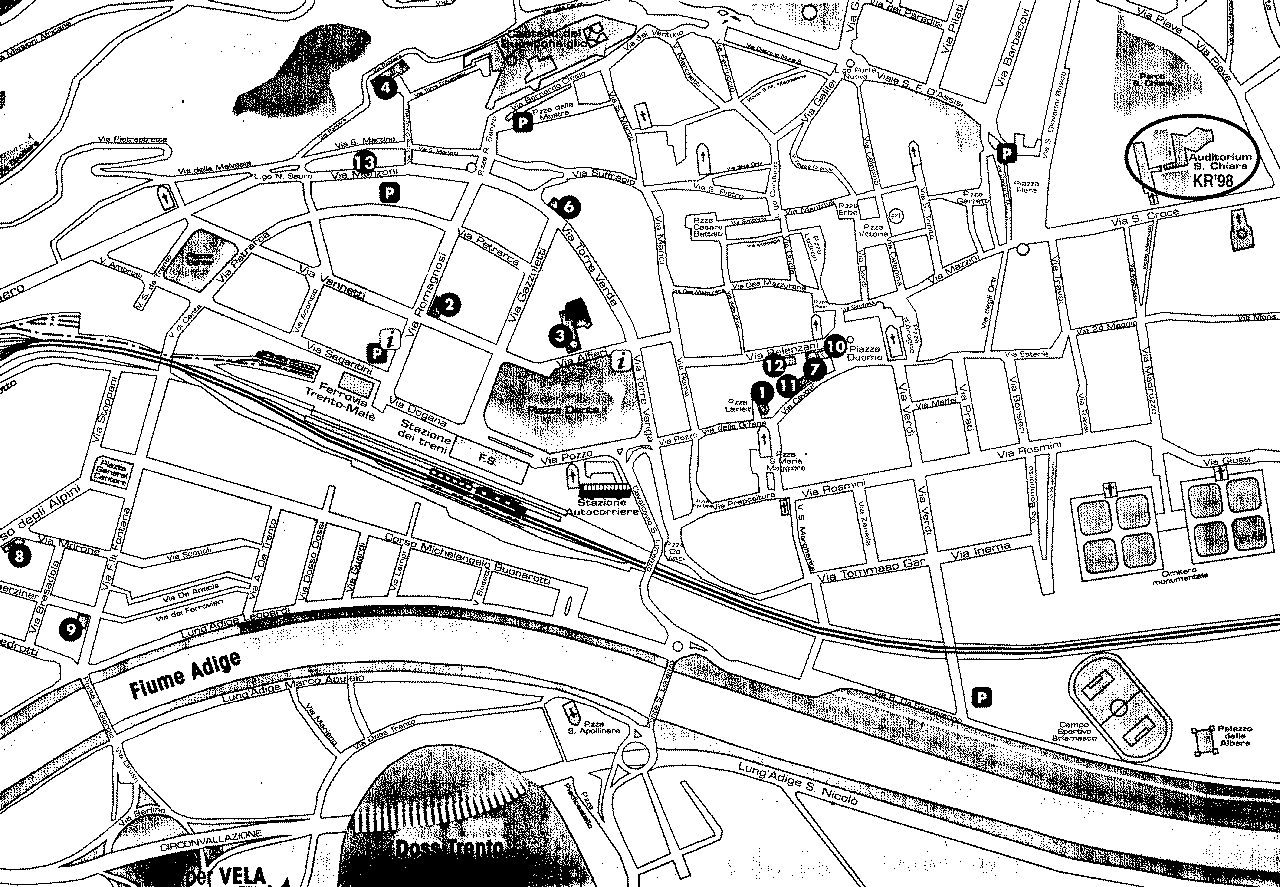
The Centro Servizi Culturali S. Chiara is located in the city center at walking distance from the Railway Station and the medieval area, where churches and other historical monuments are to be found together with elegant shops and traditional restaurants. Thus, participants will have opportunities to get out and about on relaxing walks through winding streets and beautiful piazzas. Bus transportation from the conference hotels located outside the city center to the Centro Servizi Culturali S. Chiara is included in the conference fee; check the bus schedule at the conference hotels.
Workshop participants should use the common Registration and Hotel-Banquet-Excursion forms included in this brochure. KR'98 conference registration for workshops participants is welcome but it is not mandatory. Workshops on-site registration is organized by the individual workshops.
Bus transportation from the conference hotels located outside the city center to the workshops locations is included in the each workshop registration fee; check the bus schedule at the conference hotels.
The aim of the workshop is to bring together active researchers interested in nonmonotonic reasoning to discuss current research, results, and problems of both theoretical and practical nature. The format of this workshop is different from earlier nonmonotonic reasoning workshops. NM'98 will consist of five specialized one day workshops to be held at least partly in parallel. The specialized workshops will be surrounded by a plenary program consisting of invited talks and panels. The following specialized workshops are part of NM'98:
Invited speakers are B. Kowalski, I. Levi, J. McCarthy, D. Roth, and E. Sandewall.
Participation is by invitation. Those wishing to attend without submitting a paper should send a statement of interest with a short description of research interests and recent work to one of the NM'98 Co-Chairs.
Organizers: R. Reiter (Honorary Chair), G. Brewka, I. Niemelä (Co-Chairs), E. Giunchiglia (Local Chair).
Contact persons: G. Brewka (brewka@informatik.uni-leipzig.de).
Knowledge-based Interactive Multimedia Systems (IMS) possess and utilize knowledge about their own Means and about the Function of user sessions. IMS must support users in achieving their goals and performing their tasks. They must be able to reason about users in order to collaborate effectively during determination of content and communication of information:
Major topics to be addressed by KRIMS-II include:
The target audience includes researchers in collaborative systems, personal assistants, intelligent multimedia presentation systems, adaptive interfaces, multimedia information retrieval, and intelligent integration of information.
Organizers: Marcus Herzog (TU Vienna), Paolo Petta (ÖFAI), George Vouros (Univ. of the Aegean); Supported by ÖGAI.
Contact person: Paolo Petta (paolo@ai.univie.ac.at).
Knowledge-Based Systems (KBS) are perhaps AI's most successful and visible application area. Ensuring reliability and enhancing quality of KBS are critical factors for their successful deployment in real-world applications. This is a broad task involving both methodological and formal aspects for designing rigorous validation methods and tools. The purpose of this workshop is to encourage exchange of ideas between researchers in the field of knowledge-representation with those concentrating on V&V of KBS specifically. There are obvious connections between the two fields, and we solicit papers on the following topics:
Because the aim of the workshop is to stimulate discussion, some accepted papers might be preferred over others for presentation, but all papers will be included in the printed workshop proceedings. Publication of selected papers in a coherent journal format will be considered.
Program Committee: Frank van Harmelen, Vrije Univ. Amsterdam, NL; Grigoris Antoniou, Griffith University, AU; Dieter Fensel, University of Karlsruhe, DE; Alun Preece, University of Aberdeen, UK; Marie-Christine Rousset, Universite Paris Sud, FR; Jan van Thienen, Catholic University of Leuven, BE
Contact person: Frank van
Harmelen (frankh@cs.vu.nl).
The 1998 International Workshop on Description Logics (DL'98) continues the tradition of international workshops devoted to discussing developments and applications of knowledge representation formalisms based on Description Logics. We will discuss about the foundations of Description Logics, the extensions of Description Logics, the integration of Description Logics with other formalisms, the use of Description Logics in applications, and the building of systems based on Description Logics.
DL'98 will host a DL systems comparison session. Systems will be compared on the basis of benchmarks which will be prepared in order to emphasize the best out of each system. This first round of the comparison at DL'98 will serve mostly as an evaluation of the benchmark testing set, and it is not intended to be the last word on a possible ranking. We have four aims:
Organizers: E. Franconi, chair, (IRST, ITA); G. De Giacomo (Univ. Roma, ITA); R. MacGregor (USC/ISI, USA); W. Nutt (DFKI, DE); C. Welty (Vassar College, USA); F. Sebastiani (IEI-CNR, Italy).
Contact person: Enrico Franconi (franconi@irst.itc.it).
The importance of research on ontology has been recognized in fields as diverse as qualitative modeling of physical systems, natural language processing, knowledge engineering, information integration, database design, geographic information science, and intelligent information access. Insights in this field have potential impacts on the whole area of information systems. In order to provide a solid general foundation for this work, it is important to focus on the common scientific principles and open problems arising from current tools, methodologies, and applications of ontology. The conference will have a strongly interdisciplinary character. Expected participants include computer science practitioners as well as linguists, logicians, and philosophers. Although the primary focus of the conference is on theoretical issues, methodological proposals as well as concrete applications from a well-founded theoretical perspective will be discussed:
Extra-copies of FOIS'98 proceedings will be available at the KR'98 conference desk, at the special price of 100,000 Italian lire and they can be ordered either by checking the appropriate box in the KR'98 registration form or by contacting the chair.
Conference Chair: Nicola Guarino, LADSEB-CNR, Italy (guarino@ladseb.pd.cnr.it).
This workshop is aimed at reinvigorating the historical connection between research in Natural Language Processing and Knowledge Representation. The goal is to encourage communication between the two fields, in hopes of stimulating KR research on problems of interest to the NLP community, communication of KR discoveries from the NLP community to KR researchers, and identification of existing KR techniques that may help solve problems faced by NLP researchers. Topics will include, but not be limited to:
The workshop will also address the current state of the art in broad areas of knowledge representation technology (e.g., constraint satisfaction, uncertainty, defaults) focusing on an interdisciplinary approach.
Organizers: M. Palmer (Univ. of Pennsylvania), H. Bunt (Tilburg Univ.), D. Etherington (Univ. of Oregon), F. Pianesi (ITC-IRST).
Contact person: Martha Palmer (mpalmer@linc.cis.upenn.edu).
8:45 - 9:00 Plenary Session: Open Ceremony
9:00 - 10:10 Plenary Session: Invited Talk
How
to tailor representations to different requirements
Katharina Morik
10:10 - 10:40 Coffee Break
10:40 - 12:40 Session 1: Building, Merging, Revising Theories
Description logic framework
for information integration
Calvanese, D., De Giacomo,
G., Lenzerini, M., Nardi, D., Rosati, R.
A completeness result for
reasoning with incomplete first-order knowledge bases
Levesque, H.L.
A strategy for revising
default theory extensions
Williams, M.-A., Antoniou,
G.
12:40 - 14:00 Lunch Break
14:00 - 16:00 Session 3: Logic Programming based Representations
A comparison of the static
and the disjunctive well-founded semantics and its implementation
Brass, S., Dix, J.,
Niemelä, I., Przymusisnski, T.
Preferred answer sets for
extended logic programs
Brewka, G., Eiter, T.
Dynamic logic programming
Alferes, J.J., Leite,
J.A., Pereira, L.M., Przymusinska, H., Przymusinski, T. C.
16:00 - 16:30 Coffee Break
16:30 - 18:30 Session 5: Building, Merging, Revising Theories
A general approach for
inconsistency handling and merging information in prioritized
knowledge bases
Benferhat, S., Dubois,
D., Lang, J., Prade, H., Saffiotti, A., Smets. P.
Formal theory building
using automated reasoning tools
Kamps, J.
On the logic of merging
Konieczny, S., Pino
Pèrez R.
10:10 - 10:40 Coffee Break
10:40 - 12:40 Session 2: Reasoning about Actions
Anything can happen: on
narratives and hypothetical reasoning
Karlsson, L.
Combining narratives
McCarthy, J., Costello,
T.
How (not) to minimize events
Thielscher, M.
12:40 - 14:00 Lunch Break
14:00 - 16:00 Session 4: Qualitative Spatio/temporal Reasoning
Foundations of spatioterminological
reasoning with description logics
Haarslev, V., Lutz,
C., Möller, R.
A model for reasoning about
bidemsional temporal relations
Balbiani, P., Condotta,
J.-F., Fariñas Del Cerro, L.
A qualitative theory of
motion based on spatio-temporal primitives
Muller, P.
16:00 - 16:30 Coffee Break
16:30 - 18:30 Session 6: Non Monotonic Reasoning
Comparing consequence relations
Flach, P.A.
SYSTEM JZ - How to build
a canonical ranking model of a default knowledge base
Weydert, E.
Pointwise circumscription
revisited
Amir, E.
9:00 - 10:20 Session 7: Planning
Satisfiability
planning with causal theories
McCain, N., Turner,
H.
On measuring plan quality
Lin, F.
10:20 - 10:40 Coffee Break
10:40 - 12:40 Session 9: Belief Revision and Contextual Reasoning
The PMA and relativizing
minimal change for action update
Doherty, P., Lukaszewicz,
W., Madalinska-Bugaj, Ewa
Quantifiers and operations
on modalities and contexts
Costello, T., Patterson,
A.
Local Models Semantics,
or Contextual Reasoning = Locality + Compatibility
Giunchiglia, F., Chidini,
C.
12:40 - 14:00 Lunch Break
14:00 - 15:20 Session 11: Formal Results in Spatial Reasoning
A canonical model of the
region connection calculus
Renz, J.
Undecidability of plane
polygonal mereotopology
Dornheim, C.
16:00 - 16:30 Coffee Break
9:00 - 10:20 Session 8: Efficient Modal Reasoning
More evaluation of decision
procedures for modal logics
Giunchiglia, E., Giunchiglia,
F., Sebastiani, R., Tacchella, A.
Using an expressive description
logic: FaCT or fiction?
Horrocks, I.R.
10:20 - 10:40 Coffee Break
10:40 - 12:40 Session 10: Reasoning about Actions
Concurrent actions and
interacting effects
Pinto, J.
Logic based modelling of
goal-directed behavior
Sandewall, E.J.
AOL: a logic of acting,
sensing, knowing, and only knowing
Lakemeyer, G., Levesque,
h.J.
12:40 - 14:00 Lunch Break
14:00 - 16:00 Session 12: Complexity of Reasoning
Complexity results for
independence and definability in propositional logic
Lang, J., Marquis, P.
The complexity of model
checking in modal event calculi with quantifiers
Cervesato, I., Franceschet,
M., Montanari, A.
Probabilistic deduction
with conditional constraints over basic events
Lukasiewicz, T.L.
16:00 - 16:30 Coffee Break
16:30 - 18:30 Plenary Session: Panel
Themes at the colocated
workshops
Chair: Lin Padgham
9:00 - 10:10 Plenary Session: Invited Talk
What
robots can do
Hector Levesque
10:10 - 10:40 Coffee Break
10:40 - 12:40 Session 13: Logic Programming based Representations
Specifying transactions
for extended abduction
Inoue, K., Sakama, C.
The knowledge representation
system dlv: Progress report, comparisons and benchmarks
Eiter, T., Leone, N.,
Mateis, C., Pfeifer, G., Scarcello, F.
Disjunctive ordered logic:
Semantics and expressiveness
Buccafurri, F., Leone,
N., Rullo, P.
12:40 Lunch
10:10 - 10:40 Coffee Break
10:40 - 12:40 Session 14: Planning and Execution
Modeling an agent's incomplete
knowledge during planning and during execution
Bacchus, F., Petrick,
R.
Reformulating temporal
plans for efficient execution
Muscettola, N., Morris,
P., Tsamardinos, I.
Execution monitoring of
high-level robot programs
De Giacomo, G., Reiter,
R., Soutchanski, M.
12:40 Lunch
9:00 - 10:10 Plenary Session: Invited Talk
Description
Logics and their applications
Maurizio Lenzerini
10:10 - 10:40 Coffee Break
10:40 - 12:40 Session 15: Diagnosis
On the compilability of
diagnosis, planning, reasoning about actions, belief revision,
etc.
Liberatore, P.
Compiling devices: A structure-based
approach
Darwiche, A.
Explanatory diagnosis:
Conjecturing actions to explain observations
McIlraith, S.
12:40 - 14:00 Lunch Break
14:00 - 16:00 Session 17: Reasoning about Actions
Situation calculus and
causal logic
Lifschitz, V.
Sequential, temporal GOLOG
Reiter, R.
Building models of prediction
theories
White, G., Bell, J.,
Hodges, W.
16:00 - 16:30 Coffee Break
16:30 - 17:50 Session 19: Planning
Encoding planning constraints
into partial order planners
Baioletti, M., Marcugini,
S., Milani, A.
A planning algorithm not
based on directional search
Rintanen, J.T.
10:10 - 10:40 Coffee Break
10:40 - 12:40 Session 16: Description Logics and Graph Based Languages
Characterizing the semantics
of terminological cycles in ALN using finite automata
Küsters, R.
On the decidability of
description logics with modal operators
Wolter, F., Zakharyaschev,
M.
Nested graphs: A graph-based
knowledge representation model with FOL semantics
Chein, M., Mugnier,
M.-L., Simonet, G.
12:40 - 14:00 Lunch Break
14:00 - 16:00 Session 18: Probabilistic Reasoning
Reasoning about infinite
random structures with relational Bayesian networks
Jaeger, M.
Geometric foundations for
interval-based probabilities
Ha, V., Haddawy, P.
Making decision in a qualitative
setting: from decision under uncertainty to case-based decision
Dubois, D., Godo, L.,
Prade, H., Zapico, A.
16:00 - 16:30 Coffee Break
16:30 - 17:50 Session 20: Representing Granularity and Vagueness
Modal
semantics for knowledge bases dealing with vague concepts
Bennett, B.
A theory of granularity
and its application to problems of polysemy and underspecification
of meaning
Mani, I.
The dream of a general purpose knowledge representation language has long been abandoned. However, most work on tailoring representation formalisms to particular needs has investigated deductive inference. The focus has been on inferential services for problem solving, e.g. classification or planning. The needs of the end user, be it a system (e.g., a natural language system or a robot) or a human user, determine the requirements for efficiency and expressiveness. If we focus on the knowledge engineer, additional requirements come into play: inspectability and revisability are major concerns in the process of knowledge acquisition. However, the underlying inference is still deductive. But the requirements on a knowledge representation formalism change when inductive inference is considered. A representation formalism with less expressive power may be harder to learn than a one with a higher expressive power. This means that complexity results for deductive reasoning cannot easily be transferred to inductive reasoning. Moreover, we frequently we encounter conflicting requirements for learning and problem solving. In this situation, asking for a representation that fulfills the requirements for both deductive and inductive inference, is akin to asking for a general purpose language. Instead, we design families of representations, where each family member is well suited for a particular set of requirements, and implement transformations between the representations.
In this talk, I discuss the representation family of Horn logic. Several restrictions of Horn logic have been investigated that ease learning. Three case studies illustrate how to tailor admissible languages. The first case study from a robotics application shows how a representation that is well suited for learning is transformed into an efficient deductive reasoner. The second case study exploits learning in order to enhance the understandibility and inspectability of a knowledge base under construction by a knowledge engineer. The third case study presents a tool that generates mappings from a relational database scheme to a Horn logic signature. Such mappings allow learning to take place directly from a relational database.
We propose a definition of goal achievability: given a basic action theory describing an initial state of the world and some primitive actions available to a robot, including some actions which return sensing information, what goals can be achieved by the robot? The main technical result is a proof that a simple robot programming language is universal, in that any effectively achievable goal can be achieved by getting the robot to execute one of these robot programs. Among other things, this justifies a previous specification of the planning problem in the presence of sensing. This is joint work with Fangzhen Lin.
Description Logics are logics for representing and reasoning about classes of objects and their relationships. They can be seen as successors of frame systems and semantic networks, and have been investigated for more than a decade under different points of view, in particular, expressive power and computational complexity of reasoning. In the talk, I first review the research done in the past years in Description Logics. Then I discuss the relationships with other formalisms, such as modal logics, database models, and object-oriented languages. Finally, I describe how Description Logics have been applied in several fields, including software engineering, configuration management, databases, and information systems.
| Tuesday, June 2 | 8:00 AM-6:30 PM |
| Wednesday, June 3 | 8:00 AM-6:30 PM |
| Thursday, June 4 | 8:00 AM-3:00 PM |
| Friday, June 5 | 8:00 AM-6:00 PM |
KR'98 has reserved a block of rooms in Trento and surroundings at reduced conference rates. To qualify for these rates, reservations must be made by Trentino holidays, Via Solteri 78, 38100 Trento Italy, phone +39 (461) 822-000, using the Hotel-Banquet-Excursion form included as a removable center-fold in the middle of this booklet.
A deposit of 100,000 Italian lire for each person is due to confirm the reservation request; only written and signed requests, via fax or mail, will be considered. Requests will be processed with a first-in/first-out time approach depending on availability. A confirmation will be communicated to your address in a few weeks. Full settlement will be due while checking in your hotel. Hotel cut-off date for reservations is April 30th, 1998. After cut-off, accommodations will be available on a "space available" basis only.
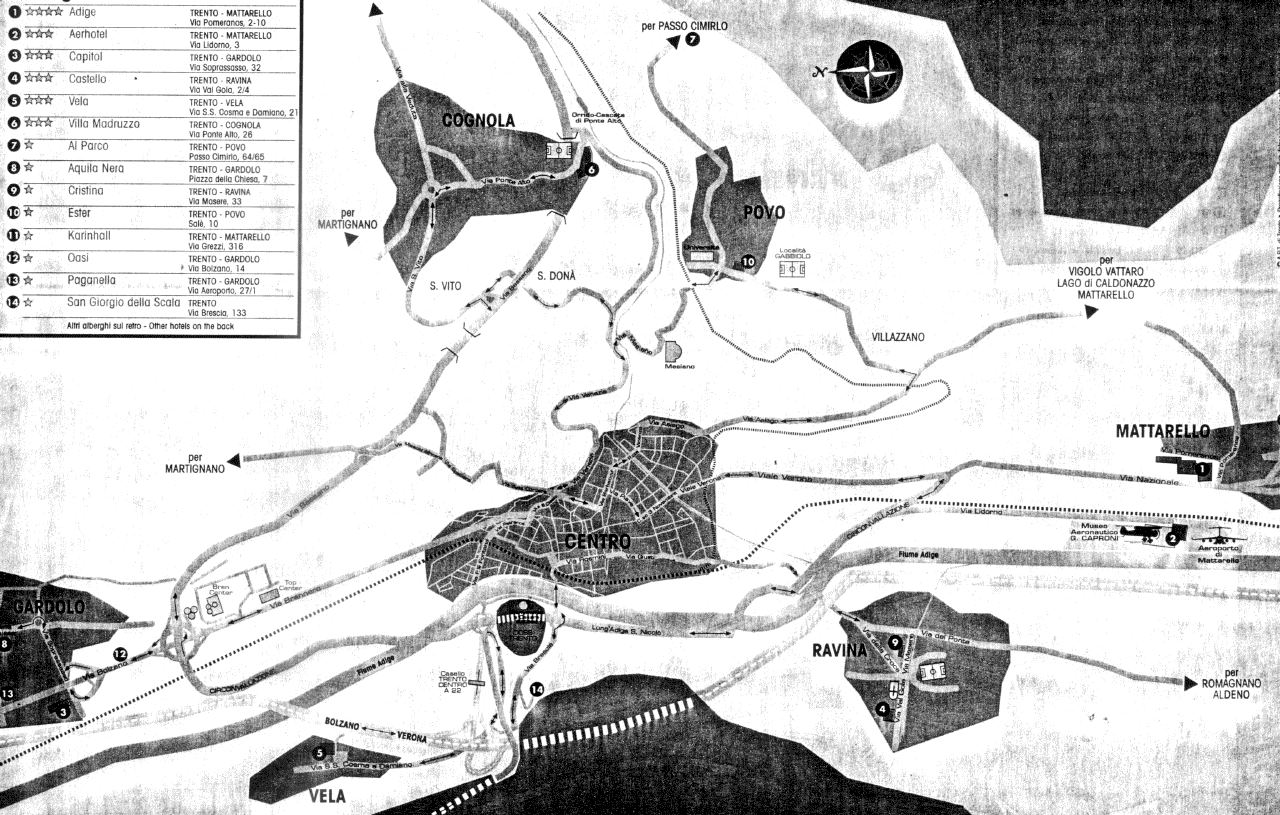
| Map | Town/ Surr. | A/C | Single | Double/ Twin | Double w. single occ. | |||
| ***** | Grand Hotel | 3 | T | Y | 175,000 | 120,000 | 185,000 | |
| ***** | Buonconsiglio | 2 | T | Y | 150,000 | 105,000 | 170,000 | |
| **** | Accademia | 1 | T | Y | 120,000 | 100,000 | 140,000 | |
| **** | Adige | 1 | S | Y | 120,000 | 90,000 | 140,000 | |
| *** | America | 6 | T | Y | 110,000 | 80,000 | 120,000 | |
| *** | Everest | 8 | T | Y | 100,000 | 80,000 | 110,000 | |
| *** | Monaco | 4 | T | Y | 105,000 | 80,000 | 125,000 | |
| *** | Villa Fontana | 9 | T | Y | 105,000 | 80,000 | 125,000 | |
| *** | Aerhotel | 2 | S | Y | 100,000 | 75,000 | ||
| *** | Capitol | 3 | S | Y | 100,000 | 70,000 | 105,000 | |
| *** | Villa Madruzzo | 6 | S | Y | 105,000 | 85,000 | 135,000 | |
| ** | Venezia (room only) | 10 | T | N | 70,000 | 55,000 | ||
| Y. Hostel (room only, enrollment document mandatory) | 13 | T | N | 40,000 | (*) 35,000 | |||
All quotations are in Italian lire per person per night with bed and breakfast accommodation, unless otherwise specified, and include bus transportation from hotels to conferences sites and vice-versa. Above listed special rates will be assumed only for requests received by April 30, 1998. You can check the map of the city and of the surroundings with the locations of hotels.
Pre-booking and pre-payment are requested using the Hotel-Banquet-Excursion form.
Pre-booking and pre-payment are requested using the Hotel-Banquet-Excursion form; correspondent amount to be added based on how many places required. Money is fully returned in case service will be canceled because minimum quantities are not reached.
![[Trento]](trento.jpg) Trento (100.000
inhabitants), the capital of the Region of Trentino and Alto Adige
(Südtirol) and of the Province of
Trentino. Trento is situated 190 m. above the sea level on the
flat ground of the Adige river Valley on the
Verona-Brennero-Innsbruck-Munich motorway and railway.
Trento (100.000
inhabitants), the capital of the Region of Trentino and Alto Adige
(Südtirol) and of the Province of
Trentino. Trento is situated 190 m. above the sea level on the
flat ground of the Adige river Valley on the
Verona-Brennero-Innsbruck-Munich motorway and railway.
The town is surrounded by beautiful mountains (the southern part of the Alps and the Dolomites) and lakes (in particular lake Garda, known for its mild climate); it is dominated by the nearby Mounts Bondone (2,170 m.) and Paganella (2,125 m.). The high craggy limestone buttresses and spires of the Dolomites soar above the conifer forests and plains surrounding their foothills, and at dawn and dusk their pinkish rock becomes tinted pastel pink, red, and violet, a spectacular sight. The valleys, woodland, grassland, and small lakes between the peaks are magnificent, and are the reason why the Dolomite mountains are famous throughout the world: almost vertical walls, hundreds of metres high, such as the Sella, the south side of the Marmolada (3,342 m.), high sharp peaks like the Madonna Peak in the Pale di San Martino, and the needles and towering rock of the very famous Torri del Vaiolet and the equally renowned Campanile Basso di Brenta, the Catinaccio, all examples of the variety of forms and appearance of these mountains. The best-known and best-equipped resorts include Cortina d'Ampezzo, San Martino di Castrozza, Ortisei, Selva di Val Gardena, Canazei, Moena, and at the foot of the Brenta group of mountains, Madonna di Campiglio.
Trento was a roman town of some importance (Tridentum) and after Goth, Lombard and Carolingian rule it passed in year 1027 from Emperor Conrad the Salic to the Bishop Princes. Though established as a satellite state of the Germanic Empire, it always had a certain independence. The Council of Trento was held here from the year 1545 to year 1563 by the Catholic Church in an attempt to curb the rapid progress of Martin Luther's Reformation. The Bishop Princes rule lasted until year 1801. Monuments include the Duomo, built in 12th-13th Century and seat of the Council of Trento, and the Castello del Buon Consiglio, an imposing building dating to various periods (original nucleus 9th Century) seat of the Bishop Princes.
Detailed information for traveling to Trento will be published at the KR'98 web site http://www.kr.org/kr/kr98/. For any further information please refer to your Travel Agent or to KR'98 Secretariat.
 Go to KR Home
Page.
Go to KR Home
Page.
franconi@irst.itc.it Last modified: Thu May 21 20:08:24 EDT 1998